What Pedestrians Lack Around the World: Auditing Street Infrastructure in Dashcam Video from 75 Cities with Vision-Language Models
Alam, M. S., Rouchitsas, A., Bazilinskyy, P.
Proceedings of the 17th International Conference on Human Interaction & Emerging Technologies (IHIET-AI). Palma de Mallorca, Spain (2027)
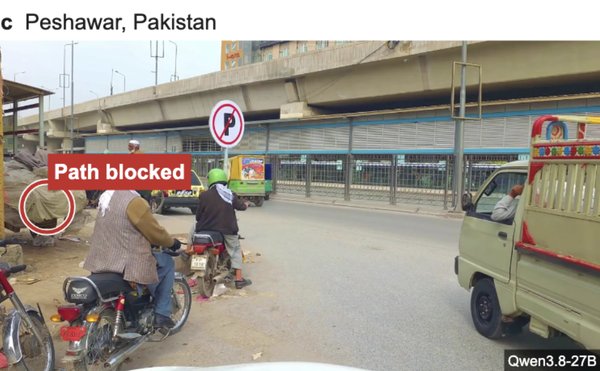
ABSTRACT Pedestrians account for almost a quarter of road deaths worldwide, and much of their risk follows from missing footways, crossings and lighting. Auditing streets in person is slow, so for most of the world’s streets, features such as footways, crossings and lighting have never been recorded. We asked whether vision-language models (VLMs), run locally, can audit pedestrian infrastructure from dashcam video and reveal differences between regions. Six open VLMs from four countries (Qwen3.8-27B, Gemma 4 31B, Molmo2-8B, InternVL3.5-8B, Ministral 3 14B and Kanana-1.5-V 3B) coded 150 clips (two per city) from 75 cities, drawn as a spatially balanced probability sample from a global dashcam dataset, with items from two established instruments: the iRAP road attributes and the MAPS-Mini streetscape audit. Each model also listed the infrastructure that was missing (needs), pointed to it in the frame and suggested a change. Validity was checked on 120 labelled JAAD clips, robustness with a reworded prompt, one frame, half resolution and resampling (8,280 answers in total), and suggestions were rated by two VLM judges. The crossing item matched human labels for five models (balanced accuracy 0.86–0.92). A missing crossing where people had reason to cross was the most common need (38% of cities; 57% in Africa), followed by footways (50% of African and 23% of North American cities). Needs rose with national road deaths (Spearman’s ρ = 0.33) and fell with median age (−0.43) and literacy (−0.44). However, the models agreed slightly less on crossings outside Europe and North America and not at all on footway type, and only the two largest models (Qwen3.8 and Gemma 4) listed needs that the judges could see. VLMs can screen streets at scale, but they are not yet most reliable where the needs are greatest. conferenceartificial-intelligencecomputer-visionpedestriandashcam