Interviewing silicon experts: A persona-based LLM interview pipeline in automated driving
Fang, Y., Bazilinskyy, P., Martens, M. H.
Adjunct Proceedings of the 18th International Conference on Automotive User Interfaces and Interactive Vehicular Applications (AutoUI). Gothenburg, Sweden (2026)
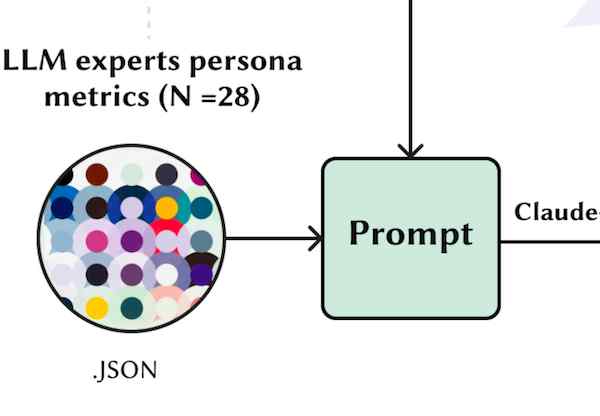
ABSTRACT Conventional human expert interviews are valuable but hampered by slow recruitment, scarce expert availability, and network-based sampling by researchers that can lead to homogeneous outputs. These constraints are particularly acute for abstract topics in human-automation interaction, which demand multidisciplinary inputs from human factors, engineering, regulatory, accessibility, and UX design disciplines. Recent work has begun to employ large language model (LLM) as instruments for knowledge elicitation. Accordingly, this paper presents a persona-based LLM expert-interview pipeline for structuring expert knowledge prior to human involvement. To simulate disciplinary diversity, we constructed a pool of 28 expert personas with structured discipline-specific profiles and first-person backstories, from which seven clearly differentiated "silicon experts" were purposively selected to balance disciplinary breadth with analytic manageability. Using the broad topic "drivers' minimum mental model (MMM)" as an example, each LLM persona responded to a structured interview protocol and returned JSON-formatted answers. The demonstration generated 58 candidate MMM items, illustrating that this pipeline design can produce concrete, traceable, and auditable outputs. The results reveal both consensus and divergence across systematically designed LLM personas. Shared priorities included drivers' responsibility, the concrete operational design domain (ODD), permitted and prohibited non-driving-related tasks (NDRTs); persona-specific contributions broadened the knowledge space to include over-the-air (OTA) updates, sensor visual limitations, and the personal perceivability of warning channels. These results position the pipeline as a preliminary scoping tool for preparing human expert interviews. Future work will examine the stability of the outputs across models variations and submit the resulting candidate items to human experts for validation. automated-drivingconferenceartificial-intelligence