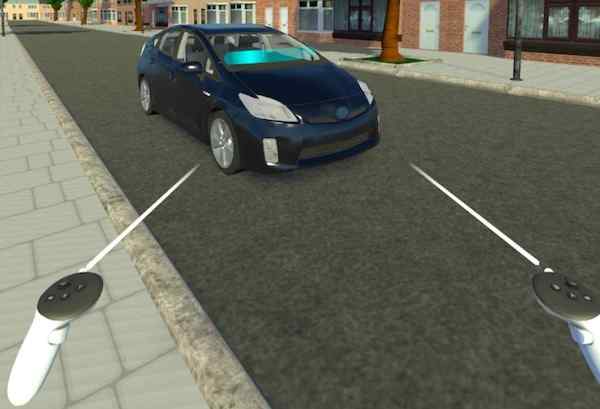
Learning a simple directional eHMI: A VR study of AV-pedestrian interaction
Janssen, C., Alam, M. S., Bazilinskyy, P., Dou, F., Zhang, L.
Adjunct Proceedings of the 18th International Conference on Automotive User Interfaces and Interactive Vehicular Applications (AutoUI). Gothenburg, Sweden (2026)
ABSTRACT External Human-Machine Interfaces (eHMIs) for automated vehicles must remain quickly interpretable if they are to scale to realistic traffic. This study examines a deliberately simple directional light-based windshield eHMI as a first step toward that goal. The eHMI uses a minimal light strip whose highlighted segment shifts based on the pedestrian’s relative position, aiming to convey yielding intent without text or complex visual elements. In a virtual-reality study with 30 participants, pedestrians encountered an automated vehicle with and without the eHMI; half received a brief onboarding video, while the others learnt through repeated exposure. Results suggest that the eHMI supported earlier crossing initiation and increased perceived safety and trust. Onboarding produced immediate benefits, whereas participants without onboarding showed gradual improvements over repeated encounters. These findings indicate that the signal is learnable in a controlled dyadic setting and motivate future VR studies of multi-pedestrian interaction, social influence, and traffic complexity. ehmipedestrianautomated-drivingvirtual-realityconference